

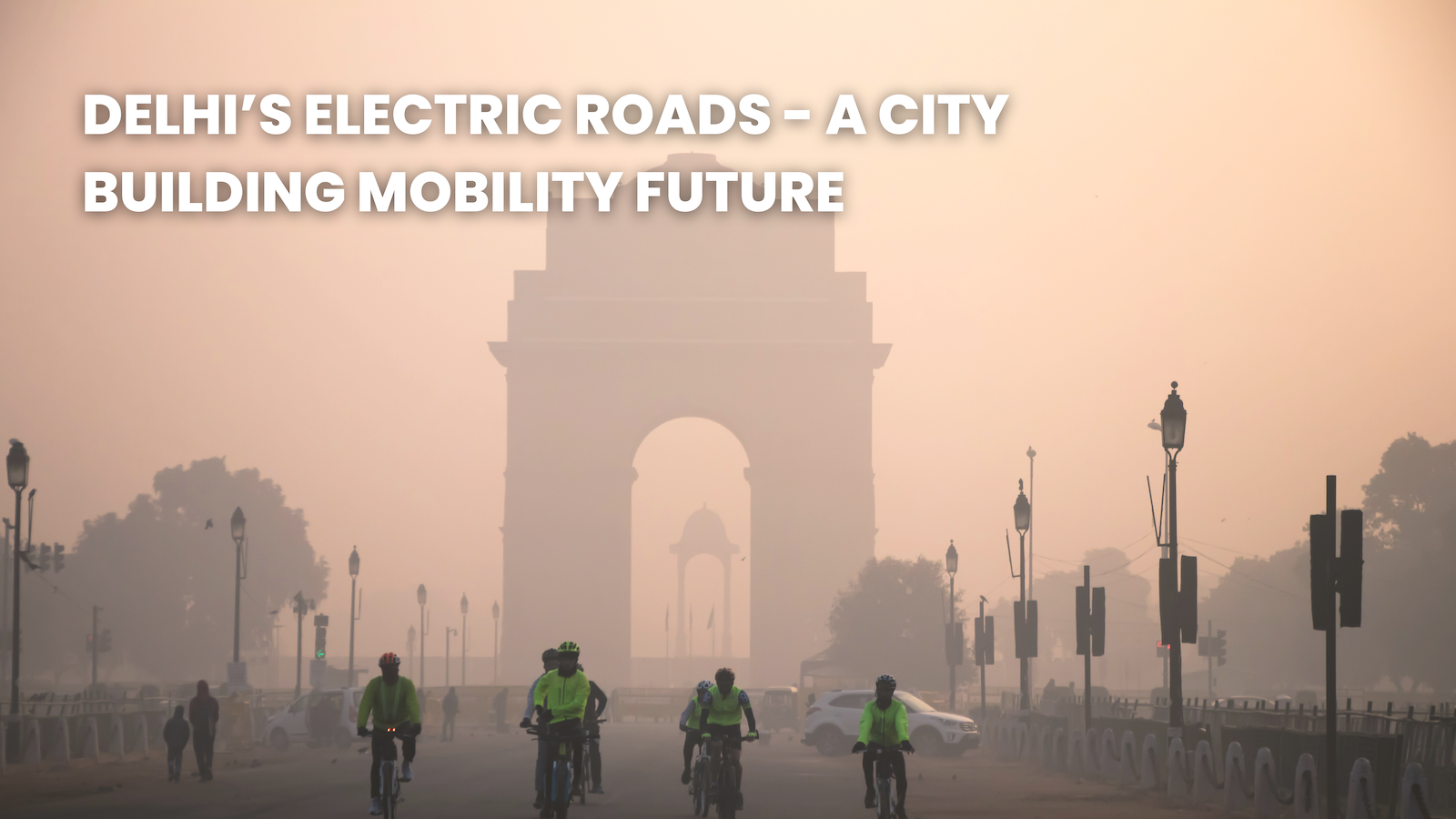
The story in India every winter is the same, with Delhi being the headline. A greyish dome settles over the city and the same question returns: why can’t India’s capital breathe? Researchers have long pointed to a complex mix that leads to this situation. Local emissions from traffic (CEEW, 2020), industry, waste burning and dust; regional inflows; and the dramatic annual spike from post-harvest residue burning in neighbouring states are a few commonly mentioned reasons (Akila, 2025). Of all the reasons listed, road transport has consistently been pointed as a major contributor adding daily, localised emissions to an already stressed airshed.
Yet, in a reversal that seemed unlikely a decade ago, the same city long portrayed as the face of India’s air-quality emergency is quietly rearranging how it moves. Not through splashy slogans, but through policy discipline and daily operational change. Delhi’s mobility transition is anchored in two pillars: a metro-first commuting culture and a systematic electrification of urban commercial and public fleets.
From metro habit to electric streets:
Between 2024–25, Delhi Metro saw unprecedented ridership peaks, almost touching 7.8–8.1 million journeys on high-demand days (Times of India, 2024b; Economic Times, 2025). In a city historically attached to private vehicles, these patterns matter. They signal a socio-behavioural transition: Delhiites are increasingly trusting public transport during congestion and during the suffocating winter smog spells.
But the metro alone cannot clean Delhi’s air. The last legs that begin and end every metro journey such as the feeder rickshaws, the last-mile scooters, the shared e-carts in markets, etc. is where Delhi’s story becomes interesting. The city has begun electrifying this connective tissue: e-rickshaws, e-autos, delivery scooters, feeder buses, and now city buses (NITI-RMI, 2022; IEA, 2024). This approach is different from cities that chase private EV car ownership as the primary metric for electrification of transport.
The Delhi EV policy shift:
When Delhi released its Electric Vehicle Policy in August 2020, the city resisted a common political temptation to centre the EV story around premium cars. Instead, the city chose the boring route of electrifying high-utilisation modes and income-linked mobility (Government of NCT of Delhi, 2020).
The policy created:
- A dedicated State EV Cell
- Incentives for e-rickshaws, e-autos, 2-wheelers, freight fleets, and buses
- A scrappage + registration incentive for commercial segments
- A public EV portal, with real charger locations and status
In 2022, Delhi advanced this foundational policy through the EV Charging and Battery Swapping Action Plan, mapping municipal land for chargers while prioritising metro nodes, markets, depots and structured parkings (Delhi EV Cell, 2022). In 2023, Delhi created the Motor Vehicle Aggregator Scheme, binding ride-hailing and gig-delivery platforms to electrification trajectories (Delhi Gazette, 2023). This was the decisive turn in building a rule-bound ecosystem rather than chasing one-time pilots.
Delhi’s electric transition:
- Public charging at ~₹2/unit through PPP
While building scattered fancy chargers seems attractive, Delhi pursued a different PPP model installing 900+ charging points across 100 sites, focusing on accessibility and equity. Tariffs were fixed at one of the lowest rates globally (~₹2/unit) (OECD-OPSI, 2023). Chargers were deliberately placed in market complexes, RWAs, bus depots, multilevel car parks, and metro vicinities for normalising electric charging as everyday civic infrastructure. The mindset in Delhi is thus not “EV = luxury amenity,” but “EV = public utility”.
- India’s largest municipal electric bus fleet
On June 5, 2025, Delhi flagged off 200 new e-buses, raising its estimated municipal electric-bus fleet to approximately 2,100 (Times of India, 2024a; Times of India, 2025). These buses operate out of modern depots equipped with rooftop solar, overnight charging, and dedicated technician teams. They serve core city corridors, ensuring clean mobility where congestion and exposure are the highest.
- Battery swapping embedded in parking and metro nodes
Delhi institutionalised battery swapping for gig workers and rickshaw operators by placing swapping stations inside multilevel car parks near metro hubs and dense commerce districts (Delhi EV Cell, 2022). For the delivery rider paid per-drop, a 45-minute charge isn’t a sustainability challenge, it’s loss of wages. Swapping battery thus bridges equity and efficiency. And these are not mere pilot announcements. They are systems operating daily in Delhi.
What do the numbers say:
Delhi’s EV dashboard tracks installed chargers, battery swapping points, charging uptime, and land-allocation progress. Thousands of public charging points and dedicated bus depots are now functional in Delhi (Delhi EV Cell, 2022). Nationally, India is now the second-largest electric 2-wheeler market and nearly one-quarter of new 3-wheelers are electric amplifying the forces that Delhi is tapping into (IEA, 2024; IEA, 2025). OEMs and OMCs are scaling fast-charge networks nationwide, but Delhi’s pioneering neighbourhood charging-first strategy is already shifting micro-travel patterns (Reuters, 2025).
The backbone of the transition:
Delhi’s electric mobility rests on three pillars:
- Capacity and Governance: A dedicated EV Cell, EV dashboards, regulatory clarity (Government of NCT of Delhi, 2020; Delhi Gazette, 2023).
- Charging as Civic Infrastructure: Visibility, affordability, zoning discipline, municipal land integration (Delhi EV Cell, 2022).
- Time-economy Rectification: Swapping where “time in seconds = wages” (NITI Aayog, 2022; ICCT-NITI, 2022).
This is not tech evangelism. It is public administration taking a systems-level approach.
Frontiers ahead:
- Moving ahead, Delhi is already discussing of the road ahead. The policy circles are now chalking out finance systems for gig-mobility. It is being noted that “subsidies start adoption; credit systems scale it”. And thus, it is being proposed that Delhi’s EV economy needs:
- Priority-sector classification
- Battery leasing models
- Credit guarantees for gig-workers
(World Bank, 2021; World Bank, 2023; NITI-RMI, 2021; ZEV-TC, 2024)
- E-rickshaws have democratized last-mile access but sometimes they congest metro precincts. A few steps that Delhi is chalking out to mitigate the same are:
- Station-aligned feeder zones
- Parking enforcement
- Queue systems (Times of India, 2025)
This is urban governance working as an engineering system which will decide whether Delhi’s EV transition stays popular and as of now, Delhi seems to be on track.
Why Delhi matters:
Electric mobility in India is not an environmental fad but rather household economics, health security, and strategic autonomy. Think of how every e-bus saves fuel and exposes fewer lungs. How every delivery scooter charging locally smoothens a family budget. How every mapped charger builds trust.
Delhi’s model is austere and not flashy. It includes public tenders, low tariffs, structured siting, depot electrification and maybe that makes it a successful model. Building on this, if other Indian cities copy a similar methodological approach of infrastructure before marketing, institutions before incentives, urban India can bend emissions without breaking livelihoods.
References:
- Akila, R., (2025). Stubble burning and its impact in Delhi’s air pollution. Applied Ecology and Environmental Research, 23(4), 7935–7956. URL: https://www.aloki.hu/pdf/2304_79357956.pdf; DOI: 10.15666/aeer/2304_79357956
- Soman, A., Kaur, H., Jain, H., & Ganesan, K., (2020, November 6). India’s electric vehicle transition: Can electric mobility support India’s sustainable economic recovery post-COVID-19? Council on Energy, Environment and Water. URL: https://www.ceew.in/publications/indias-electric-vehicle-transition-electric-mobility-support-sustainable-economic-recovery
- Delhi EV Cell, (2022). Charging/Swapping Infrastructure Action Plan For Delhi 2022-25. Government of NCT of Delhi. URL: https://ev.delhi.gov.in/files/Charging%20Action%20Plan%20of%20Delhi.pdf
- Delhi Gazette, (2023). Delhi Motor Vehicle Aggregator and Delivery Service Provider Scheme, 2023. Government of NCT of Delhi. URL: https://transport.delhi.gov.in/sites/default/files/Transport/circulars-orders/motor_vehicle_act-hindi-english_23052023.pdf
- Economic Times, (2025, August 9). Delhi Metro records highest-ever ridership with over 81 lakh journeys on Raksha Bandhan eve. The Economic Times. URL: https://economictimes.indiatimes.com/news/new-updates/delhi-metro-records-highest-ever-ridership-with-over-81-lakh-journeys-on-raksha-bandhan-eve/articleshow/123204164.cms?from=mdr
- Government of NCT of Delhi, (2020, August 7). Delhi Electric Vehicle Policy 2020. Transport Department, Government of NCT of Delhi. URL: https://powermin.gov.in/sites/default/files/uploads/EV/Delhi.pdf
- Hindustan Times, (2025, August 9). Delhi Metro hits record ridership of 81.87 lakh on eve of Raksha Bandhan. Hindustan Times. URL: https://www.hindustantimes.com/india-news/delhi-metro-hits-record-ridership-of-81-87-lakh-on-eve-of-raksha-bandhan-101754758375865.html
- IEA, (2024). Global EV Outlook 2024, IEA, Paris. URL: https://www.iea.org/reports/global-ev-outlook-2024
- IEA, (2025). Global EV Outlook 2025, IEA, Paris. URL: https://www.iea.org/reports/global-ev-outlook-2025
- NITI Aayog, (2022, April). Draft Battery Swapping Policy. Government of India. URL: https://www.niti.gov.in/sites/default/files/2022-04/20220420_Battery_Swapping_Policy_Draft.pdf
- NITI Aayog, (2022, May). Battery Swapping For Electric Two-Wheelers In India: Strategy Hinterlands. ICCT-NITI. URL: https://www.niti.gov.in/sites/default/files/2022-05/Battery_swapping_report_09052022.pdf
- NITI Aayog, RMI, & RMI India, (2022, January). Banking on electric vehicles in India: A blueprint for inclusion of EVs in priority sector lending guidelines. Government of India / RMI India. NITI-RMI, 2022. URL: https://www.niti.gov.in/sites/default/files/2022-01/Banking-on-EV_web_2.0a.pdf
- NITI Aayog & RMI, (2021, January). Mobilising finance for EVs in India: A toolkit of solutions to mitigate risks and address market barriers. Government of India / RMI. NITI-RMI, 2021. URL: https://www.niti.gov.in/sites/default/files/2023-02/RMI-EVreport-VF_28_1_21.pdf
- OECD-OPSI, (2023). Delhi’s model of EV charging infrastructure — ensuring the cheapest EV charging rates in the world. OECD. URL: https://oecd-opsi.org/innovations/delhis-model-of-ev-charging-infrastructure-ensuring-the-cheapest-ev-charging-rates-in-the-world/
- Reuters, (2025, February 14). FACTBOX What are India’s EV makers’ plans for their charging networks? Reuters. URL: https://www.reuters.com/business/autos-transportation/what-are-indias-ev-makers-plans-their-charging-networks-2025-02-13/#:~:text=Feb%2013%20(Reuters)%20%2D%20Indian,setup%20of%20fast%2Dcharge%20stations.
- Sharma, S., (2024a, April 15). Delhi to add 2,800 e-buses next year under central scheme. The Times of India. URL: https://timesofindia.indiatimes.com/city/delhi/delhi-to-add-2800-e-buses-next-year-under-central-scheme/articleshow/124259832.cms
- Times of India, (2024b, November 19). Delhi Metro records highest-ever daily ridership amid severe pollution crisis. The Times of India. URL: https://timesofindia.indiatimes.com/india/delhi-metro-records-highest-ever-daily-ridership-amid-severe-pollution-crisis/articleshow/115452948.cms
- Times of India, (2025, June 6). For Clean & Green Delhi, 200 E-Buses Flagged Off. The Times of India. URL: https://timesofindia.indiatimes.com/city/delhi/for-clean-green-delhi-200-e-buses-flagged-off/articleshow/121656595.cms
- World Bank. (2021). Electric Mobility in India: Accelerating Implementation. World Bank Group. URL: https://documents1.worldbank.org/curated/en/772841622724981757/pdf/Electric-Mobility-in-India-Accelerating-Implementation.pdf
- World Bank, (2023). Electric Mobility & Power Systems: Impacts and Mitigation Strategies in Developing Countries. World Bank Group. URL: https://documents1.worldbank.org/curated/en/099050123125542493/pdf/P1746590c032c506708d4905fad210b582c.pdf
- Zero-Emission Vehicles Transition Council (ZEV-TC), UNEP, IFC & ADB, (2024). Navigating India’s EV financing landscape. URL: https://zevtc.org/wp-content/uploads/2024/04/Navigating-Indias-EV-Financing-Landscape.pdf